Showing posts with label History. Show all posts

Sunday, July 3, 2011

Causes Of World War 2

Free Shipping to Australia and New Zealand at AbeBooks
The Second World War was caused by:

a. Hitler’s Aims

  1. To unite German speaking people (using NSD which had been denied at the Treaty of Versailles.
  2. He wanted lebensraum (living space) in order to gain self-sufficiency (autarky)
  3. He wanted to dominate Europe and the World
To achieve any of these aims would involve breaking the Treaty of Versailles (28/6/1919), and this could lead to war.

b. The aggression of Hitler’s Allies

  1. Italy – Mussolini wanted a Fascist-Roman empire in the Mediterranean and Africa (e.g. Abyssinian invasion in 1935.)
  2. Japan – Japan wanted a Nipponese empire in the Pacific, extending into China and Australia (e.g. Manchurian invasion in 1931)
Germany, Italy and Japan were hostile to Communism (USSR), and this way a cause of war and vice versa.

c. Democratic powers were passive

  1. USA – Isolated
  2. France – France was unlikely, and reluctant, to intervene against Germany, because she could not rely on Britain’s and America’s support.
  3. Britain – Between 1934 and 1937, Britain was sympathetic to German recovery. Between May 1937 and March 1939, Britain appeased Germany.
These powers could have stopped Fascist aggression earlier than 1939.

d. The League of Nations failed to keep peace

See other notes.

Conclusion

War was caused by a combination of ‘a’ to ‘d’, but Hitler’s aims and actions were the main cause of war.

Reasons for Causes of War

Refer to map showing nine causes of war.
The Second World War was caused by Fascist aggression and the failure of democratic powers to stop this aggression.
  1. The rearmament of Germany was a cause for war because it broke the Treaty of Versailles (28th June, 1919)
  2. The remilitarization of the Rhineland (7th march, 1936) was a cause of war because it broke the Treaty of Versailles and the Locarno Pacts (1925)
  3. The Rome-Berlin Axis (October 1936) was a cause of war because it united the aggressive fascist powers and divided Europe into hostile camps.
  4. Chamberlain’s appeasement policy (after may 1937 – March 1939) was a cause of war because it broke the Treaty of Versailles and Treaty of St. Germain (10th September, 1919)
  5. The Anschluss of Germany with Austria (13th march, 1938) was a cause of war because it broke the Treaty of Versailles and Treaty of St. Germain (10th September, 1919)
  6. The Nazi annexation of the Sudetenland after the Munich conference (29th September 1938) was a cause of war, because it broke the Treaty of St. Germain.
  7. The Nazi occupation of Czechoslovakia in March 1939, cause war because it defied the Munich agreement and ended Britain’s appeasement policy.
  8. The Nazi-Soviet Pact (29th August 1939) caused war because it sealed Poland’s downfall.
  9. The Nazi invasion of Poland (1st September 1939) caused war because Britain had guaranteed Poland’s borders.

Causes of the Second World War (Detail)

See Map and Summary Sheet

Nine Steps to War

1. The Rearmament of Germany

German rearmament began after Hitler left 1932-4 Geneva Disarmament Conference, stating that as the powers would not disarm to his level, he would rearm Germany to their level. By 1935 rearmament was well underway. This involved conscription and munitions factories.
Rearmament alarmed the French who, feeling insecure, reinforced the Maginot line (built between 1929 and 1934). This was a line of steel and concrete fortifications stretching from Belgium to Switzerland and was called ‘a gate without a fence’ because Germany would be able to avoid it and invade France via Belgium. France remained passive without Britain’s support.
Britain was sympathetic towards Germany and even signed an Anglo German naval Treaty (June 1935) allowing Germany’s navy to be 35% of the size of the Royal Navy. Hitler used his new found arms to support Franco in the Spanish Civil War (1936-9) Hitler sent the Condor Legion of the Luftwaffe to bomb Guernica on 26th April, 1937. Guernica was razed to the ground and Franco went on to conquer the Basque areas of Spain. Hitler had used Spain as a practise ground.

2. The Remilitarization of the Rhineland (1936)

Having broken the Treaty of Versailles once, Hitler risked doing it a second time by marching 30,000 troops into Cologne on 7th March 1936. France, with 250,000 troops mobilised, remained passive because Britain would not support her. Britain took the view that Germany was ‘marching into her own back yard.’
To show that his remilitarization was popular, Hitler held a plebiscite, which showed that 98.8% were in favour. He went on to build his own defensive fortification, the Siegfried Line.

3. The Rome Berlin Axis (October 1936)

Originally Mussolini did not want to be Hitler’s ally and in 1935 talks were held with Britain and France at the Stresa Front, but these came to nothing when Anthony Eden of Britain threatened oil sanctions against Mussolini during the Abyssinian crisis. This caused the Rome-Berlin Axis in 1936. Mussolini and Hitler strengthened their alliance on two occasions
  1. The Anti-Commintern Pact (November 1937) with Japan.
  2. The Pact of Steel (May 1939).

4. Britain’s policy of Appeasement (May/June 1937 – March 1939)

Neville Chamberlain became British Prime Minister on 28th May 1937, and followed the policy of appeasing Germany, believing that all Hitler wanted to do was unite German speaking people. In so doing, Hitler would break the Treaty of Versailles (28th June 1919) but Chamberlain did not believe Hitler would cause war. Churchill disagreed, citing Mein Kampf (1924) where Hitler had written that Germany must regain lands ‘in the East … by the power of the sword.’
Chamberlain had misinterpreted Hitler’s aims. (We have the benefit of hindsight.)

5. The Anschluss with Austria (13th March, 1938)

Austrian Fascists wanted to unite with Germany but Schuschnigg, the Austrian Chancellor, wanted Austria to be independent. He was unable to gain support from abroad (France and the Little Entente) so agreed to meet Hitler in Berlin. He was persuaded to accept Hitler’s henchman Seyss-Inquart as Minster of the Interior. Rioting in Vienna increased under Seyss-Inquart’s leadership and Schuschnigg resigned. Seyss-Inquart invited Hitler to assist him and on 13th March, 1938 troops from the Wermacht entered Austria. In a plebiscite on the Anschluss a vote of 99.75% in favour was recorded. This was ‘rigged’ by biased questioning. Hitler made it seem that he had been invited into Austria, in fact he had incited the union.

6. Hitler Gained the Sudetenland (29th September, 1938)

The Sudetenland was lost by Austria in the Treaty of St. Germain (10th September 1919) and hereby Czechoslovakia gained 3 million German speaking people. After the Anschluss the Sudeten German leader, Konrad Henlein, demanded a union with Germany. Unable to receive help from France, the Czech Premier, Benes, mobilised alone. Fearing war, Chamberlain met Hitler on three occasions at Berchtesgaden, Godesburg and at Munich.
Munich Agreement (29th September, 1938)
This was signed by Hitler, Mussolini, Chamberlain and Daladier. Benes was not present. It said:
  1. Hitler could take the Sudetenland the following day without a plebiscite
  2. Hungary and Poland could take border districts from Czechoslovakia
  3. Britain and Germany would never go to war.
Chamberlain’s Reaction
On his return to England, Chamberlain announced that he had gained ‘peace with honour, peace in our time’. The majority rejoiced, except Churchill.
Hitler’s Reaction
In public Hitler seemed satisfied, but in private he exploded saying ‘that fellow Chamberlain has spoiled my entry into Prague.’

7. The Fall of Czechoslovakia (March 1939)

In March 1939, Hitler forced Lithuania to give him Memel where most people spoke German. So far Hitler had only taken German speaking territory, so Chamberlain could still appease Hitler. However, in March 1939, Hitler threatened to bomb Prague, so the Czechs surrendered. Chamberlain realised appeasement had failed, so he began to rearm Britain and guarantee peace in Poland.

8. Nazi-Soviet Pact (29th August, 1939) – The Ribbentrop-Molotov Pact

By the summer of 1939, Hitler’s plans to invade Poland were complete. He realised that to invade Poland mighty cause Britain to attack him from the West but he was more concerned to avoid a Russian attack from the east. Therefore to avoid a war on two fronts, he arranged the Nazi-Soviet Pact, which said that if either country went to war the other would remain neutral.
Hitler gained the chance to invade Poland with a war on one front, if Britain supported Poland.
Stalin of USSR gained time to rearm in case Hitler attacked him later, and the chance to gain the eastern half of Poland. This would provide the USSR with a bufferzone.

9. German Invasion of Poland (1st September, 1939)

German tanks invaded West Prussia and Posen on the 1st September 1939 using blitzkrieg tactics. (This is a lightning, sudden attack co-ordinating air, then land forces). Chamberlain sent an ultimatum (a warning with a threat) saying that if Hitler did not withdraw from Poland by 11am, 3rd September 1939, Britain would declare war. On 3rd September, Britain, followed by France, declared war on Germany.

Causes of the Second World War - Vocabulary

  • Lebensraum – living space, e.g. Hitler’s aim to take land from bordering states to achieve self-sufficiency (autarky)
  • Anschluss – union, e.g. Austria and Germany (March, 1938)
  • Appeasement – to give into an aggressor little by little, in the hope of preventing war. E.g. Britain appeased Germany (May/June 1937 – March 1939)
  • Blitzkrieg – lightning attack, co-ordinating air and land forces. e.g. Germany’s attack on Poland (1st September 1939)
  • Remilitarization – rearming and area, e.g. Germany remilitarized the Rhineland (1936)
  • Plebiscite (referendum) – a vote on an issue, e.g. Hitler’s plebiscites on remilitarization and the Anschluss of Austria and Germany (Hitler fixed his referendums in 1936 and for the Anschluss in 1938, so no-one expected him to have a plebiscite for the Sudetenland. He fixed them by biased questioning.)
  • Ultimatum – a warning with a threat, e.g. Britain’s ultimatum for Hitler to leave Poland by 11am on the 3rd September 1939.
  • Buffer zone – a protective barrier of land, e.g. Eastern Poland taken by the USSR as protection against a future German attack.
  • Rearmament – manufacturing of weapons and conscription, e.g. Germany (after 1934), Britain after the taking of Sudetenland
  • Autarky – self-sufficiency economically, e.g. Germany under Hitler and Schacht to enable Germany to avoid imports
  • Aggression – hostile or violent action, e.g. Germany was aggressive towards Czechoslovakia (March, 1939) and Poland (1st September, 1939)
  • Diktat – none-negotiated decision/arrangement, e.g. The Munich Agreement, forced onto Czechoslovakia (1938)
  • Passive – to spectate, i.e. not take part in the action, e.g. Britain and France were passive towards the German remilitarization of the Rhineland (March 1936)
  • Incite – devious planning, e.g. Hitler incited the Anschluss (March, 1938)

Causes of the Second World War (Summary)

Long term, Short term and Immediate Causes

Long term

  1. The harshness of the Treaty of Versailles (28th June, 1919) on Germany:
    • Land losses
    • Reparations
    • War Guilt
  2. The failure of the League of the Nations to:
    • Keep peace
    • Bring about disarmament

Short term

  1. a. Hitler’s aggression:
    • His aims
    • His actions (see steps to war: 1,2,3,5,6,7,8,9)
  2. The aggression of the other powers:
    • Italy – Abyssinia (1935), Rome-Berlin Axis, Anti-Commintern Pact, Albania
    • Japan – Manchuria (1931), Anti-Commintern Pact (November, 1937)
    • Russia – Nazi-Soviet Pact, Invasion of Poland
  3. The democracies were too passive
    • USA – isolation
    • France – would not do anything without Britain’s support
    • Britain – sympathetic towards Germany, e.g. Anglo-German Naval Treaty (1935) and later appeased her (May/June 1937 – March 1939)

Immediate

  1. German invasion of Poland (1st September, 1939)
© 2010-2012 The Little Ganesha® All Rights Reserved.

Wednesday, May 18, 2011

Mount Rushmore History

Mount Rushmore

Mount Rushmore Mount Rushmore National Memorial is as much a product of dreams and determination as it is the work of a talented sculptor.Â
Mount Rushmore National Memorial is as much a product of dreams and determination as it is the work of a talented sculptor.

The Father of Rushmore

In 1923, Doane Robinson, the aging superintendent of the South Dakota State Historical Society, had a vision of a massive mountain memorial carved from stone so large it would put South Dakota on the map. Robinson told all who would listen of his dream of giant statues of Western figures such as Chief Red Cloud, Buffalo Bill Cody, Lewis and Clark, and legendary Sioux warriors marching along South Dakota's skyline. Robinson spoke to local organizations and wrote letter upon letter.
Many South Dakotans be-lieved that a colossal sculpture would attract thousands of visitors with heavy wallets. Others found the notion ludicrous. Finally, when the newspaper stories stopped and the snickers ceased, Robinson enlisted the aid of the one man he knew could carry the torch—the respected U.S. Senator Peter Norbeck.
Norbeck, a frequent visitor at the White House, had the admiration of his peers in the Senate as well as that of the farmers and ranchers of South Dakota who had sent him to Washington. Robinson's mountain-carving proposal captured the senior senator's imagination and he encouraged the historian to seek a sculptor capable of commanding such a project.
Sculptor Gutzon Borglum, one of America's most prolific artists, received a letter from Robinson proposing the project in August 1924. It couldn't have come at a more opportune moment; he was fed up with the project he was working on. Borglum, a fiery and stubborn artist, lived for visions, not setbacks. He accepted Robinson's offer.

Mixed Signals

Calling Cards - 468x60
Upon his arrival in September 1924, the flamboyant Borglum politely, but forcefully informed Robinson and Norbeck that his life's work would not be spent immortalizing regional heroes. The sculptor insisted that the work demanded a subject national in nature and timeless in its relevance to history.
By selecting four great presidential figures for the carving, the trio sought to create an eternal reminder of the birth, growth, preservation and development of a nation dedicated to democracy and the pursuit of individual liberty.
Borglum soon embarked on a site-searching trip to find a grouping of rocks massive enough to support a giant sculpture. He examined the Needles, as Robinson suggested, but found the rock too brittle for carving and the spires disproportionate to the human form. He left and returned next year. It was on Borglum's second trip that he found Mt. Rushmore August 13, 1925. Next, Borglum and his party climbed Harney Peak. At 7,242 feet, this is the highest point between the Rockies and the Swiss Alps. The surrounding vista inspired him.
"Here is the place!" Borglum exhorted. "American history shall march along that skyline."
He set his sights on the craggy, pine-clad cliff known as Mount Rushmore, near the isolated mining town of Keystone. It had southeastern exposure, giving it direct sunlight most of the day, and was made of sound granite relatively free from fracture. Borglum carefully explored the crevices and sampled the rock of Mount Rushmore. With each test, he reconfirmed that he had found his mountain.

The Waiting Game

Senator Norbeck and Congressman William Williamson easily secured federal legislation to allow a mountain carving in Harney National Forest. A similar bill in the state Legislature was passed in 1925.
But months passed as supporters of the Rushmore project scrambled for funding. Environmentalists suggested the project would deface the mountainside. Others asked how a mortal sculptor could hope to improve on what a higher authority had already designed. As the calendars changed to 1926, most South Dakotans dismissed the whole fanciful conception.

Presidential Attention

Then, in the spring of 1927, President Calvin Coolidge decided to spend his three-week summer holiday in the Black Hills.
State officials immediately began preparing for the visit by remodeling the rustic State Game Lodge in Custer State Park, which was selected to be Coolidge's "summer White House."
On June 15, Senator Norbeck and 10,000 South Dakotans warmly greeted President and Mrs. Coolidge, their two dogs and the First Lady's pet raccoon, as they stepped from the train in Rapid City. They were soon settled comfortably into the Game Lodge and the Dakotan way of life. Their three-week visit turned into a three-month stay.
Coolidge couldn't have known that his fishing skills were greatly enhanced by park officials. Before the president's arrival, chicken wire was stretched across the creek upstream and downstream from the president's quarters. Lunker trout from a nearby fish hatchery were trucked in nightly—so many that Coolidge couldn't help but fill his creel as he "learned to fish."
This extended vacation allowed Borglum and Norbeck enough time to convince Coolidge to participate in the formal dedication of Mount Rushmore. On August 10, the president rode horseback to the mountain, sporting cowboy boots and a 10- gallon hat given to him by local residents.
"We have come here to dedi-cate a cornerstone laid by the hand of the Almighty," Coolidge told a crowd of 1,000 South Dakotans. In an impassioned speech by a man not known for his passion, Coolidge became the first to refer to Mount Rushmore as a "national shrine," then pledged federal support for the project.
After listening with satisfaction to the president's remarks, the 60-year-old Borglum climbed to the mountain's craggy summit and symbolically drilled six holes to mark the commencement of carving. The Mount Rushmore dream would em-brace the remaining 14 years of his life and leave a monument unlike any other.

Men and Mountain

At first, it was just a job, a way to put food on the table. But, as the four faces emerged from the granite, the men who helped carve the memorial began to share the sculptor's dream. These drill-dusty, unemployed miners, who had originally sought only a paycheck in the heart of the Great Depression, became caught up in a challenge that would produce a national treasure.
In the six-and-a-half years of work that occurred on and off between 1927 and 1941, Borglum employed almost 400 local workers. Some built roads, ran the hoist house, generated power or sharpened thousands of bits for the pneumatic drills. Others set dynamite charges or completed delicate finishing work on the sculpture.
Among the most highly skilled workers were those using dynamite. Using techniques he had developed at Stone Mountain and relying on skills his crew had acquired in mining, Borglum used the explosive in an innovative way that helped to remove large amounts of rock quickly and relatively inexpensively. His powder men became so skilled that they could blast to within four inches of the finished surface and grade the contours of the lips, nose, cheeks, neck and brow. In fact, 90 percent of the 450,000 tons of granite removed from the mountain was taken out with dynamite.

Model to Masterpiece

Borglum created a model of the four presidents on a 1-to-12-inch scale, meaning an inch on the model represented a foot on the cliff. This model has been preserved for viewing at the Sculptor's Studio. To transfer measurements from the model to the mountain, workers determined where the top of the head would be, then found the corresponding point on the model. A protractor was mounted horizontally on top of the model's head. A similar, albeit 12 times larger, apparatus was placed on the mountain. By substituting feet for inches, workers quickly determined the amount of rock to remove.
Drillers then used the same measuring system and air-powered tools to drill closely spaced holes to exacting depths, a process known as "honeycombing." The rock between these holes was then broken away using chisels and hammers. The final process, known as "bumping," used a pneumatic drill and a special bit to leave the finished surface as smooth as a concrete sidewalk.
A skilled driller could make $1.25 per hour on the project which was better than the mines were paying. But Borglum's crew often had to endure extended layoffs due to a lack of funds and harsh winter weather. When spring or more funding came again, the workers would report back to the mountain, eager to get back to work on their adopted cause.
As his dream neared its completion, Borglum's biggest fear was leaving a mystery for future generations. In 1938, Borglum began carving a giant vault in the canyon wall directly behind Mount Rushmore. Into this great hall, he planned to place records of the memorial, of Western civilization, of individual liberty and freedom. But Borglum's death and the country's entry into World War II intervened, and the Hall of Records was left unfinished. (In 1998, the National Park Service completed a scaled down version of the hall.)
After Borglum's death, his son, Lincoln, spent another seven months refining the monument. On October 31, 1941, he stopped construction on the sculpture, leaving Mount Rushmore as we know it today: a truly American icon.

Thursday, April 28, 2011

Cold Wars

Cold War: Postwar Estrangement

The Western democracies and the Soviet Union discussed the progress of World War II and the nature of the postwar settlement at conferences in Tehran (1943), Yalta (February 1945), and Potsdam (July-August 1945). After the war, disputes between the Soviet Union and the Western democracies, particularly over the Soviet takeover of East European states, led Winston Churchill to warn in 1946 that an "iron curtain" was descending through the middle of Europe. For his part, Joseph Stalin deepened the estrangement between the United States and the Soviet Union when he asserted in 1946 that World War II was an unavoidable and inevitable consequence of "capitalist imperialism" and implied that such a war might reoccur.
The Cold War was a period of East-West competition, tension, and conflict short of full-scale war, characterized by mutual perceptions of hostile intention between military-political alliances or blocs. There were real wars, sometimes called "proxy wars" because they were fought by Soviet allies rather than the USSR itself -- along with competition for influence in the Third World, and a major superpower arms race.
After Stalin's death, East-West relations went through phases of alternating relaxation and confrontation, including a cooperative phase during the 1960s and another, termed dtente, during the 1970s. A final phase during the late 1980s and early 1990s was hailed by President Mikhail Gorbachev, and especially by the president of the new post-Communist Russian republic, Boris Yeltsin, as well as by President George Bush, as beginning a partnership between the two states that could address many global problems.
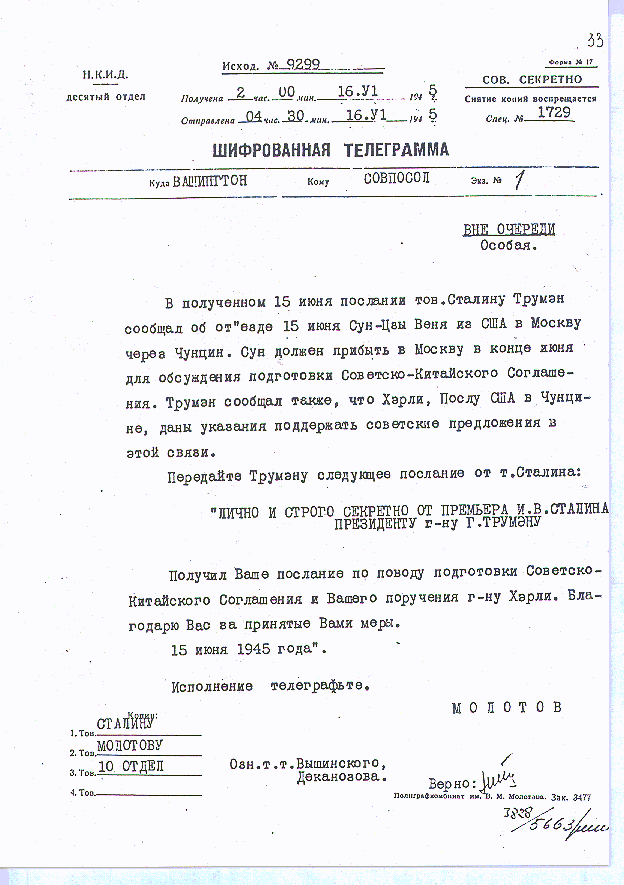
Telegram to President Truman

Cold War: Soviet Perspectives


After World War II, Joseph Stalin saw the world as divided into two camps: imperialist and capitalist regimes on the one hand, and the Communist and progressive world on the other. In 1947, President Harry Truman also spoke of two diametrically opposed systems: one free, and the other bent on subjugating other nations.
After Stalin's death, Nikita Khrushchev stated in 1956 that imperialism and capitalism could coexist without war because the Communist system had become stronger. The Geneva Summit of 1955 among Britain, France, the Soviet Union, and the United States, and the Camp David Summit of 1959 between Eisenhower and Khrushchev raised hopes of a more cooperative spirit between East and West. In 1963 the United States and the Soviet Union signed some confidence-building agreements, and in 1967 President Lyndon Johnson met with Soviet Prime Minister Aleksei Kosygin in Glassboro, New Jersey. Interspersed with such moves toward cooperation, however, were hostile acts that threatened broader conflict, such as the Cuban missile crisis of October 1962 and the Soviet-led invasion of Czechoslovakia of 1968.
The long rule of Leonid Brezhnev (1964-1982) is now referred to in Russia as the "period of stagnation." But the Soviet stance toward the United States became less overtly hostile in the early 1970s. Negotiations between the United States and the Soviet Union resulted in summit meetings and the signing of strategic arms limitation agreements. Brezhnev proclaimed in 1973 that peaceful coexistence was the normal, permanent, and irreversible state of relations between imperialist and Communist countries, although he warned that conflict might continue in the Third World. In the late 1970s, growing internal repression and the Soviet invasion of Afghanistan led to a renewal of Cold War hostility.
Soviet views of the United States changed once again after Mikhail Gorbachev came to power in early 1985. Arms control negotiations were renewed, and President Reagan undertook a new series of summit meetings with Gorbachev that led to arms reductions and facilitated a growing sympathy even among Communist leaders for more cooperation and the rejection of a class-based, conflict-oriented view of the world.
With President Yeltsin's recognition of independence for the other republics of the former USSR and his launching of a full-scale economic reform program designed to create a market economy, Russia was pledged at last to overcoming both the imperial and the ideological legacies of the Soviet Union.
Hypermedia exhibit note: The following image is truncated in its original form for reasons unknown.
Exposing Imperialist Policies

Cold War: Cuban Missile Crisis


According to Nikita Khrushchev's memoirs, in May 1962 he conceived the idea of placing intermediate-range nuclear missiles in Cuba as a means of countering an emerging lead of the United States in developing and deploying strategic missiles. He also presented the scheme as a means of protecting Cuba from another United States-sponsored invasion, such as the failed attempt at the Bay of Pigs in 1961.
After obtaining Fidel Castro's approval, the Soviet Union worked quickly and secretly to build missile installations in Cuba. On October 16, President John Kennedy was shown reconnaissance photographs of Soviet missile installations under construction in Cuba. After seven days of guarded and intense debate in the United States administration, during which Soviet diplomats denied that installations for offensive missiles were being built in Cuba, President Kennedy, in a televised address on October 22, announced the discovery of the installations and proclaimed that any nuclear missile attack from Cuba would be regarded as an attack by the Soviet Union and would be responded to accordingly. He also imposed a naval quarantine on Cuba to prevent further Soviet shipments of offensive military weapons from arriving there.
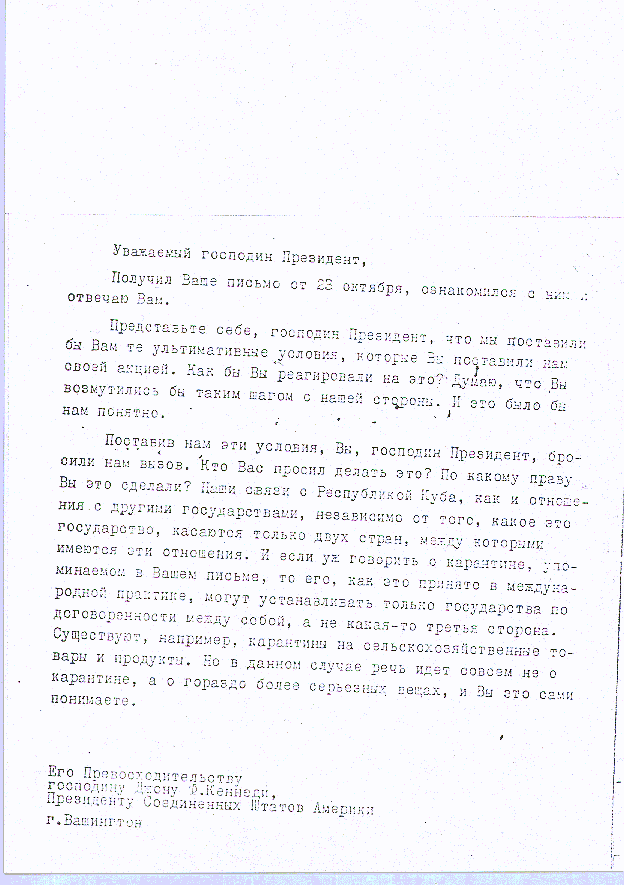
During the crisis, the two sides exchanged many letters and other communications, both formal and "back channel." Khrushchev sent letters to Kennedy on October 23 and 24 indicating the deterrent nature of the missiles in Cuba and the peaceful intentions of the Soviet Union. On October 26, Khrushchev sent Kennedy a long rambling letter seemingly proposing that the missile installations would be dismantled and personnel removed in exchange for United States assurances that it or its proxies would not invade Cuba. On October 27, another letter to Kennedy arrived from Khrushchev, suggesting that missile installations in Cuba would be dismantled if the United States dismantled its missile installations in Turkey. The American administration decided to ignore this second letter and to accept the offer outlined in the letter of October 26. Khrushchev then announced on October 28 that he would dismantle the installations and return them to the Soviet Union, expressing his trust that the United States would not invade Cuba. Further negotiations were held to implement the October 28 agreement, including a United States demand that Soviet light bombers also be removed from Cuba, and to specify the exact form and conditions of United States assurances not to invade Cuba.
Khrushchev to John F. Kennedy